You are herePosture

Posture


  • Reduce Pain
  • Improve Recovery
  • Prevent Injuries
  • Increase Sports Performance

Aligning the Spine

Posture

“Stand up straight!? “Pull your shoulders back!? As children, we were told to have good . Yet we were seldom taught effective ways to accomplish this. Indeed, we were often not even told just what “good ? is.
The consequences of this information gap can be seen all around us: stiff necks, shoulders hunched forward or pulled tightly back, restricted breathing, and tightness in the thighs, legs and ankles. Backaches, headaches, and other painful symptoms are often the unfortunate result.
Causes of poor
The causes of poor can be divided into two categories: positional and structural. Structural causes are basically permanent anatomical deformities not amenable to correction by conservative treatments. Positional causes of poor include


Ergo Rule Number One: Good Posture and Back Support

It may sound like a cliche, but remember what your parents told you: Don't slouch. "If you're slouching, that puts stress on your lower back, you overuse those muscles and then you become fatigued and have soreness and discomfort," says Charles Kopin, ergonomic specialist for Industrial Health Care in Waterbury, Conn.

Your head should be directly over your shoulders, back should be straight and resting against the chair back (ideally with support in the lower curve of the back, or lumbar), knees should be slightly higher than the hips, and feet should be able to rest on the floor.

"That () gives the spine a tremendous amount of strength," says Scott Bautch, chiropractor in Wausau, Wisc. "It keeps the pressure on the bony part of the spine, which is meant to carry weight, and keeps it off the disc," which can only take pressure for short intervals, he says.


Correcting Faulty Posture

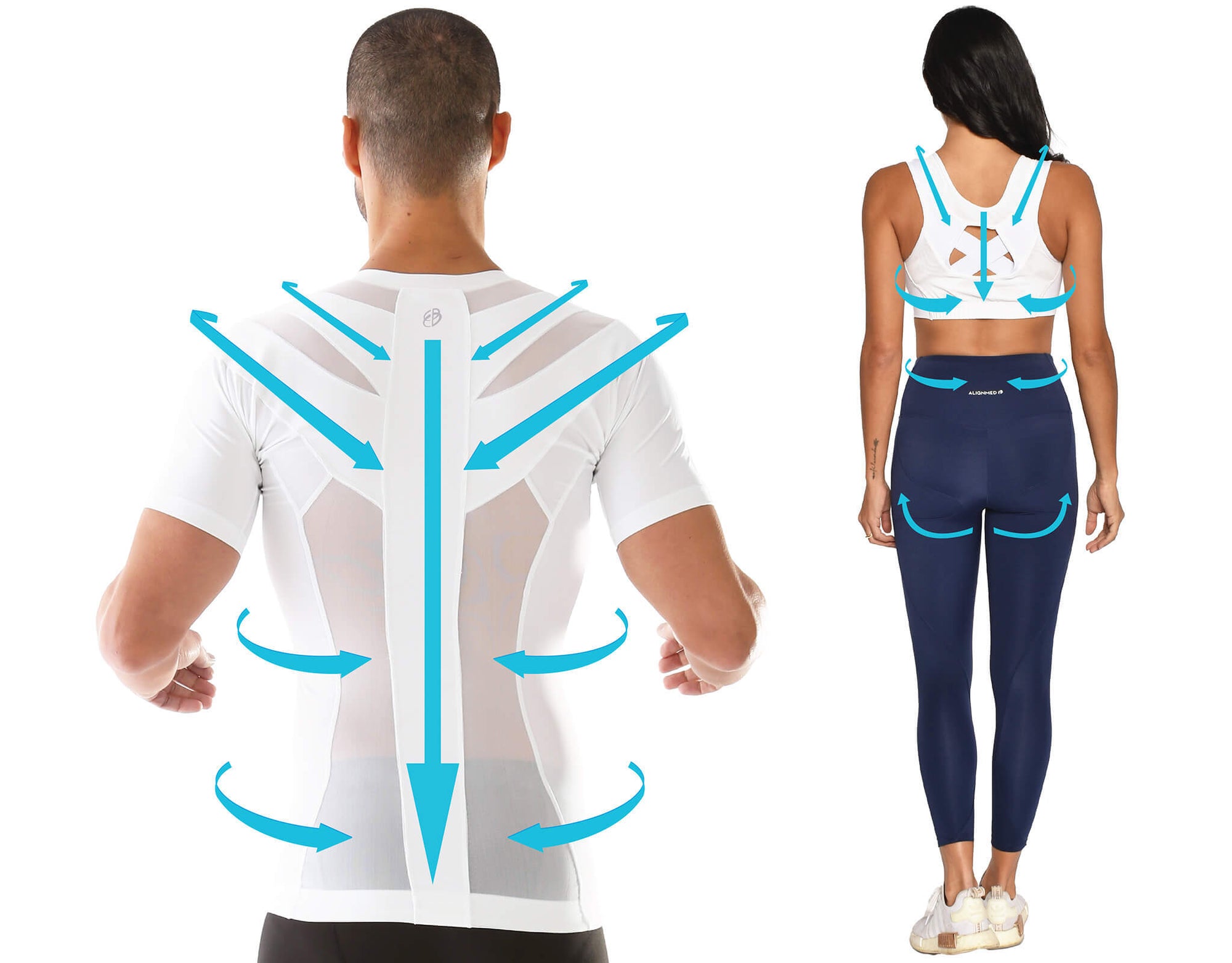
Posture is essentially the position of the body in space. Optimal is the state of muscular and skeletal balance that protects the supporting structures of the body against injury or progressive deformity, whether at work or rest. Correct involves the positioning of the joints to provide minimum stress on the joints of the body. Conversely, faulty increases stress on the joints. This increased stress can be compensated for by strong muscles, but if they are weak or the joints lack mobility or are too mobile joint wear and modification can occur. As well, damage and changes to the surrounding tissues can occur.


Human Posture

Barlow

Dr. Wilfred Barlow, a Rheumatologist, did extensive research on human and authored the Book, The Alexander Principle. His book suggests ways to correct your and highlights medical problems that can arise from faulty . The medical problems discussed in Dr. Barlow's books are Rheumatism, Arthritis, Cervical Spondylosis, Back Pain, Breathing Disorders, Stress Disorders and Gastro-intestinal Disorders. Dr Barlow estimates that 99% of adults will have faulty (more on this later).

Speculation on human forms part of our philosophical, social and cultural heritage. Human beings have pondered this subject from ancient times. In India, around 400 BC, the discipline of Yoga took shape to help invigorate the body, calm the mind, and to develop ones hidden mental and spiritual powers. Over the past hundred years, many other disciplines such as Chiropractics, Osteopathy, Rolfing and The Alexander Method of correction have evolved to help individuals cope with their . You can find out more on these subjects in the Internet.


Why Do I Need Good Posture?

#1
I Sit All Day. How Will Posture Exercise Help Me?

Twenty first century life has created the 21st century . We use our bodies differently than our grandparents did. We sit far more than a human body was designed to.

Muscles come in sets, and every muscle has a partner muscle for balance. When we sit, we only use one muscle in a set. So, when we sit for much of our day, we are overusing some muscles and under-using others.

Posture exercises are designed to stretch the over-used muscles, and stengthen the neglected muscles.

#2
I Exercise A Lot, Why Do I Need To Do Posture Exercises?


The Body Will Adapt To Posture & Motion Changes

1st Posture Principle
Posture Is How You Balance Your Body

If you don't balance, you fall down! Our bodies would fall forward without muscles pulling us back.
We use our muscles reflexively to balance when we sit, stand, sleep, or work. In order for us to balance, our brain integrates information from three sources to know where the body is in space.

* The eyes: We see what is level.
* The ears: The inner ear tells the brain where each ear is in relation to the other ear.
* The muscles and joints: We feel balanced (or unbalanced) based upon information sent from the muscles and joints. The brain assumes we are balanced when we sense equal stress on both sides of the body.


Zazen Posture

Buddhism began in northern India about 2,500 years ago with the enlightenment of Shakyamuni Buddha. Since that time Buddhism has traveled throughout the countries of Asia. As it traveled from country to country, it incorporated the cultural customs and celebrations of each culture it traveled to and the Buddhist texts were translated into the local languages. Over time variations developed and different schools with different practices were formed. This is why a Tibetan Buddhist monk or the Dalai Lama for example will wear different robes for monks in Viet Nam, Korea Sri Lanka or Japan.

The Zen School of Buddhism developed in China about 1,000 years after Shakyamuni Buddha lived.


Alexancer Technique and Posture

The and movements of small children are a joy to watch. But as we start to grow older and tense ourselves in reaction to life's worries and concerns, our deteriorates, often quite seriously. Our shoulders may become hunched, our necks stiff, and we sit either slumped or holding ourselves in a rigid upright position.

We have a series of reflexes throughout the body that support us against the force of gravity and naturally co-ordinates our movements. Inappropriate muscular tension creates an interference with these reflexes and the result is that many of us move in ways that are awkward and inefficient. This can give rise to a wide range of common ailments such as arthritis, neck and back pain, migraine and sciatica.


Correct Posture

I remember thinking as a first grader that sitting up straight was
somehow an important thing for me to be doing. At the time, it was
primarily a matter of what I thought the teacher expected of us kids.
But now, after practicing Aikido Kokikai for a number of years, I've
realized that correct posture is far more important than it seemed back
in grade school, when I sat in my little wooden chair with my back
straight and my chest out. (Until, after a few minutes, I got sick of it
and went back to slumping.)

We've all heard that the mind leads the body. This is an important
realization; that by changing what you believe, you can actually change.